Cyberpunk 2077 Ultimate Edition: A Puzzling Platform Divide
Cyberpunk 2077 Ultimate Edition's physical release format and PS5 Phantom Liberty voucher controversy highlight a perplexing decision for collectors.
I've been following the Cyberpunk 2077 saga since its rocky launch, and just when I thought CD Projekt Red had finally turned things around with the stellar 2.0 update and the mind-blowing Phantom Liberty expansion, they've managed to create another controversy. This time, it's not about bugs or performance issues—it's about something far more perplexing: the physical release format of the Ultimate Edition.
As someone who's invested countless hours in Night City, I was genuinely excited when the Ultimate Edition was announced. These complete packages are usually a no-brainer for collectors like myself—everything bundled together, often with some fancy new artwork, and occasionally sporting those prestigious Game of the Year banners. It seemed like the perfect way to commemorate Cyberpunk's redemption arc.
The Disc Dilemma That Nobody Saw Coming
Here's where things get weird. I discovered that the PS5 version of Cyberpunk 2077 Ultimate Edition won't actually include the Phantom Liberty DLC on the physical disc. Instead, PlayStation players like myself will receive a voucher code to download the expansion separately. Meanwhile, Xbox and PC players get the complete experience on their physical media. This inconsistency left me scratching my head, wondering why CD Projekt Red would create such an uneven playing field.
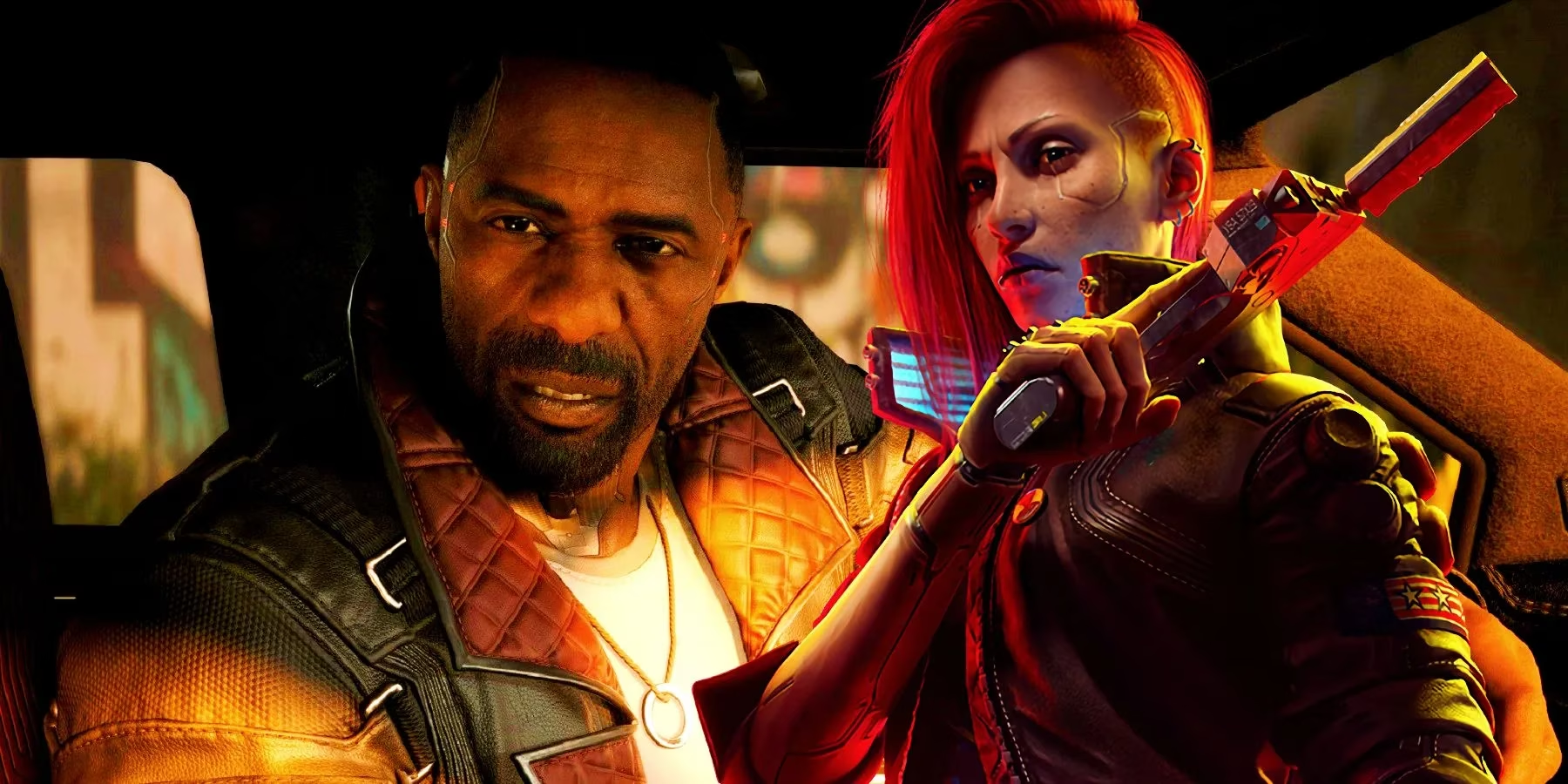
The Phantom Liberty expansion is absolutely phenomenal—it's the content that truly elevated Cyberpunk 2077 from a troubled launch to a genuinely exceptional RPG experience. Not having it on the disc feels like receiving a beautifully wrapped gift box that's only half full. For collectors and physical media enthusiasts, this decision stings particularly hard.
Understanding Sony's Unique Requirements
After digging deeper into this situation, I came across some enlightening information from John Linneman at Digital Foundry. Apparently, Sony has a peculiar policy that requires developers to create an entirely new Stock Keeping Unit (SKU) whenever they want to include DLC directly on a game disc. This isn't just a simple matter of burning some extra data onto the disc—it involves:
-
Complete game recompilation: The entire game needs to be rebuilt from scratch
-
Resubmission for licensing approval: Sony's certification process must be repeated in full
-
Significant time investment: Weeks or potentially months of additional development work
-
Substantial financial costs: Resources that could be allocated elsewhere
From a business perspective, I can understand why CD Projekt Red might have balked at these requirements. They've already invested heavily in fixing the game, developing the 2.0 update, and creating Phantom Liberty. Asking them to jump through additional bureaucratic hoops just to satisfy Sony's unique SKU requirements seems excessive.
A Pattern Across PlayStation Releases
What really surprised me was learning that this isn't an isolated incident. Several high-profile PlayStation releases have employed the same voucher-based approach:
| Game Title | Edition | Platform | DLC Delivery |
|---|---|---|---|
| Marvel's Spider-Man | GOTY Edition | PS4 | Voucher Code |
| Nier: Automata | GOTY Edition | PS4 | Voucher Code |
| Resident Evil Village | Gold Edition | PS4/PS5 | Voucher Code |
| Star Wars Battlefront | Ultimate Edition | PS4 | Voucher Code |
| Mortal Kombat 11 | Ultimate Edition | PS5 | Voucher Code |
Seeing this pattern makes the situation slightly less frustrating, but it doesn't completely eliminate the disappointment. These are all major AAA titles from respected publishers, yet they've all had to navigate Sony's restrictive policies in the same way.
The Collector's Perspective 🎮
As someone who values physical game collections, this trend troubles me deeply. There's something special about owning a complete game on physical media—it's tangible proof of ownership that doesn't depend on server availability or digital storefront policies. When I purchase an "Ultimate Edition," I expect it to be truly ultimate, containing everything on the disc itself.
The voucher code approach introduces several concerns:
-
Long-term accessibility: What happens when PlayStation Network eventually shuts down support for PS5? Will these DLC codes still be redeemable?
-
Resale value: A used copy without a valid code is essentially incomplete
-
Internet requirements: Players without reliable internet connections face unnecessary barriers
-
Digital preservation: Future generations may struggle to experience the complete game
Is It Still Worth Purchasing? 💭
Despite my frustrations with the format, I have to admit that the Ultimate Edition still represents solid value. You're getting the base game and the exceptional Phantom Liberty expansion for essentially the price of the base game alone. The content itself is absolutely worth experiencing—Night City has never looked better, and the new Dogtown district introduced in Phantom Liberty is a masterclass in atmospheric world-building.
The 2.0 update fundamentally transformed Cyberpunk 2077's systems:
-
⚡ Completely revamped skill trees and progression
-
🚗 Improved vehicle handling and police AI
-
🎯 Enhanced combat mechanics and enemy behavior
-
📱 Redesigned UI and inventory management
-
🌃 Better performance across all platforms
Combined with Phantom Liberty's gripping spy-thriller narrative, incredible new characters like Solomon Reed, and meaningful choices that actually impact the story, this is genuinely the definitive Cyberpunk experience.
The Broader Industry Implications
This situation highlights a growing tension in the gaming industry between physical and digital distribution. As we move further into 2026, I've noticed more publishers treating physical releases as afterthoughts, with day-one patches, mandatory downloads, and now, off-disc DLC becoming increasingly common.
Sony's SKU policy, while presumably designed to maintain quality control and proper cataloging, seems increasingly outdated in an era where games receive constant updates and expansions. Microsoft and PC platforms have apparently found ways to accommodate on-disc DLC without such restrictive requirements, which raises questions about whether Sony's approach truly serves players' best interests.
My Final Thoughts
Looking at my gaming shelf, I see dozens of Ultimate Editions, Game of the Year releases, and Complete Collections—each one a testament to a game's journey from launch to its final, polished form. The Cyberpunk 2077 Ultimate Edition will join that collection, but it'll always feel slightly incomplete knowing that a crucial piece of the experience exists only as a redeemable code rather than on the disc itself.
CD Projekt Red has worked incredibly hard to redeem Cyberpunk 2077, transforming it from a cautionary tale about overpromising into a genuine masterpiece of open-world RPG design. It's unfortunate that Sony's policies have prevented them from delivering the complete physical package that this remarkable comeback story deserves.
For Xbox and PC players, congratulations—you're getting the authentic Ultimate Edition experience. For my fellow PS5 players, we'll have to settle for something slightly less ultimate, even if the actual content remains just as spectacular. Here's hoping that future releases find better solutions to this increasingly common problem, because physical media collectors deserve better than half-measures and workarounds.
At the end of the day, whether you're downloading Phantom Liberty via voucher or installing it from disc, you're still getting one of the best RPG experiences available in 2026. Night City awaits, choombas—just make sure you've got a stable internet connection ready. 🌆✨